
Slinky Background
Hand reaching for a chess piece on a chessboard surrounded by other pieces.

Scientific
Research

Clinical evidence from studies using Tyromotion devices
proves the impact of our rehabilitation technologies.

Evidence that moves neurorehabilitation forward.

We collaborate with clinics, therapists, and research partners worldwide to continuously validate and advance evidence-based rehabilitation technologies.

Publication date
2026
2025
2024
2023
2022
2021
2020
2019
2018
2017
2016
2014
2013
2012
2011
Device (1)
Lexo
Amadeo
Diego
Omego Plus
Pablo
Tymo
Myro
Indication
Brain Injury
Brain Tumor
Cancer
Cervical or lumbal spine instability
Charcot Marie Tooth
Geriatric
Guillain Barrè syndrome
Hand Surgery
Healthy Adults
Motorneuron disease
Muscular disease
Multiple Sclerosis
Neurologic
Normal Pressure Hydrocephalus (NHP)
Orthopedic
Parkinson’s Disease
Patients
Pediatric
Polytrauma
Pusher Syndrom
Radial nerve injury
Rehabilitation Experts
Shoulder prosthesis
Spinal Cord Injury
Stroke
Therapists
Upper limb fractures/surgery
Morochovičová I, Hreha R, Burda R, Morochovič R. Wien Klin Wochenschr. 2026 Jan 19.
Guerrini A, Siotto M, Fasano A, Cocco C, Germanotta M, Cipollini V, Cortellini L, Pavan A, Lattanzi S, Insalaco S, Antonacci E, Ruco E, Khazrai YM, Aprile IG. Front Nutr. 2025 Dec 17;12:1694609.
Vyskotová J, Pařízková L, Aláčová PG, Konečný P. Journal REHABILITÁCIA, 62(4), 237–251.
Shierk A, Frederiksen A, Reyes F, Chapa S, Clegg N, Cates L, Roberts H. Occup Ther Health Care. 2025 Dec 9:1-19.
Platz T, Laborn T, Laborn M, Kaiser K. Neuroreha 2025; 17(04): 174-179.
Cocco C, Siotto M, Guerrini A, Germanotta M, Falchini F, Cipollini V, Cortellini L, Pavan A, Lattanzi S, Insalaco S, Papadopoulou D, Ruco E, Antonacci E, Aprile IG. Neurol Int. 2025 Nov 30;17(12):193.
Gower V, Hamilton T, Spinelli F, Randazzo M, Aprile IG, Falchini F, Germanotta M, Gramatica F, Wagner T, Krebs HI. Sci Rep. 2025 Nov 19;15(1):40720.
Kochman MT, Kielar A, Kasprzak M, Kasperek W, Dutko M, Vellender A, Przysada G, Drużbicki M. Sensors (Basel). 2025 Oct 26;25(21):6597.
Kilkki MM, Poutanen J, Kauranen K, Arokoski J, Hiekkala S. JMIR Rehabil Assist Technol. 2025 Oct 2;12:e78091.
Leszczak J, Wołoszyn N, Brożonowicz J, Bylicki K, Ciąpała G, Grzegorczyk J, Wiśniowska-Szurlej A. Med Sci Monit. 2025 Jul 29;31:e949357.
Tramonti C, Gnetti B, Gemignani P, Callegari S, Germanotta M, Cecchi F, Aprile IG, Balbi P. Eur J Transl Myol. 2025 Oct 2;35(3):12758.

Study Blog

Cost-effectiveness of Rehabilitation Robotics

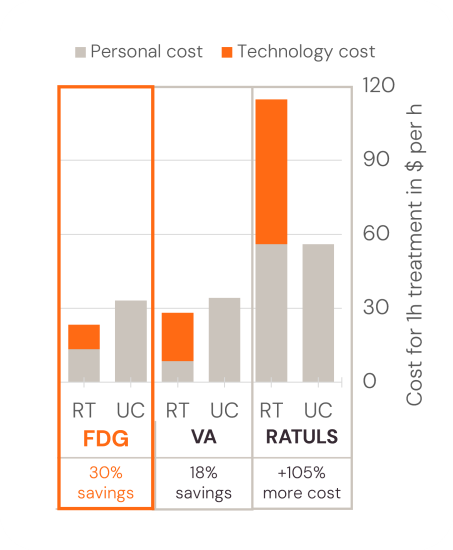
This milestone study evaluates cost-effectiveness in upper-limb robotic rehabilitation after stroke by comparing organizational models across three major RCTs. Results indicate that higher therapist-to-patient ratios and efficient device use allow for substantial cost reduction: FDG (Italy) achieved 30% savings (6187 h/year, 1:3 ratio), VA Robotics (US) achieved 18% savings (4300 h/year, 1:4), while RATULS (UK) reported 105% higher costs (1820 h/year, 1:1). The Fondazione Don Gnocchi (FDG) model applies technology-assisted group therapy using Tyromotion devices (Amadeo, Diego, Pablo). Integrating robotic and conventional therapies can lower costs per treatment hour and increase accessibility by enabling treatment of more patients or more therapy time per patient.

Multicenter RCT
Upper Limb Robotic Group Therapy

A multicenter RCT in eight rehabilitation centers of the Fondazione Don Gnocchi (FDG, Italy) evaluated robot-assisted upper limb treatment in 247 patients with subacute stroke. A new organizational model in which one therapist supervises three patients (1:3 ratio) using a set of complementary devices (Amadeo, Diego, Pablo) was compared with conventional therapy (1:1 ratio). Patients received 45 minutes of either robotic or conventional therapy daily, 5 days per week, for 30 sessions. Both groups achieved clinically meaningful improvements in upper limb motor function, activities of daily living, and participation, with the robotic group showing significantly greater gains in muscle strength.

Lexo Robotic Gait Training in Patients
with Various Neurological Diseases

In a multiple-case study, the Reha Zentrum Münster (Austria) investigated Lexo robot-assisted gait training in patients with common and rare neurological diseases, including stroke, multiple sclerosis, Parkinson’s Disease, and spinal cord injury. Patients underwent Lexo training for 45 minutes per day, 4 days per week, for 4 weeks. High patient acceptance was shown by high recruitment, retention, and adherence rates, while walking ability, speed, distance, and functional mobility improved. Lexo robot-assisted gait training showed clinically meaningful changes in walking and high goal attainment. These findings reinforce the growing importance of innovative technology in neurological rehabilitation.

Robotic Hand Rehabilitation
in Parkinson’s Disease

A randomized controlled trial from the research group of IRCCS Bonino Pulejo Messina and Rocco Salvatore Calabrò investigated the effects of robotic-assisted hand therapy with Amadeo compared to conventional physical therapy in 40 people with Parkinson’s disease. Patients received 36 hours of either robotic or conventional therapy over 8 weeks. The Amadeo group showed superior improvements in both cognitive function and hand motor control. Importantly, perceived stigma decreased significantly in the robotic group. These findings suggest that intensive, technology-assisted rehabilitation can play a meaningful role in enhancing outcomes and support the integration of robotic rehabilitation into PD management.

Intensive Upper Limb
Outpatient Service

Professor Thomas Platz investigated the effects of a 2-week course of intensive impairment-oriented arm rehabilitation in a 1:1 patient-therapist setting of the outpatient service Laborn, Germany. For 40 hours over 2 weeks, 100 patients (90% with severe arm paresis) received technology-assisted arm rehabilitation combined with Arm Basis Training (ABT) or Arm Ability Training (AAT). During 75% of the training time (30 hours) Tyromotion devices were used. Results show that the intensive program is feasible for severely affected chronic stroke survivors and leads to clinically meaningful gains, significantly improving motor function through (partial) restoration of function and transfer of training gains into everyday use of the affected limb.


Validity and Reliability
of the Tymo Balance Test

In a validity and reliability study, Tymo was compared with a laboratory force platform. The results show that Tymo provides measurement accuracy comparable to a gold-standard device, with very strong correlations in center of pressure paths. Clinical validity of the Tymo balance test was shown in stroke patients through its correlations with the Berg Balance Test, and reliability through repeated measurements. Compared with the Berg Balance Test, the Tymo Balance Test is faster and easier to conduct and does not suffer from ceiling effects. Overall, Tymo provides a clinically valid and reliable balance assessment and a portable practical alternative to traditional lab-based systems.

Research Initiatives